2026-03-05
What Is Machine Learning? A Plain-English Guide
Introduction
You've heard the term "machine learning" dozens of times. It comes up in conversations about AI, in tech news, in job listings, and in product descriptions.
But what does it actually mean?
Machine learning is not a brand. It's not a specific app. It's a fundamental technique — a way of building software that is completely different from traditional programming.
Once you understand the core idea, a lot of the AI landscape suddenly makes sense.
Traditional Programming vs Machine Learning
To understand machine learning, start by understanding what came before it.
Traditional programming
In traditional programming, a developer writes explicit rules that the computer follows.
For example, to build a spam filter the old way:
- If the email contains "WIN A PRIZE" → mark as spam
- If the email contains "click here to claim" → mark as spam
- If the sender is unknown → increase spam score
The programmer has to think of every possible rule. As spam evolved, programmers had to constantly write new rules to keep up.
This approach works for simple, predictable problems. But it breaks down quickly when the world is complex and messy.
Machine learning
Machine learning flips this process around.
Instead of writing rules, you give the system examples.
- Here are 10,000 emails we know are spam.
- Here are 10,000 emails we know are legitimate.
- Figure out the pattern yourself.
The machine learns the rules from the data, rather than being told the rules explicitly.
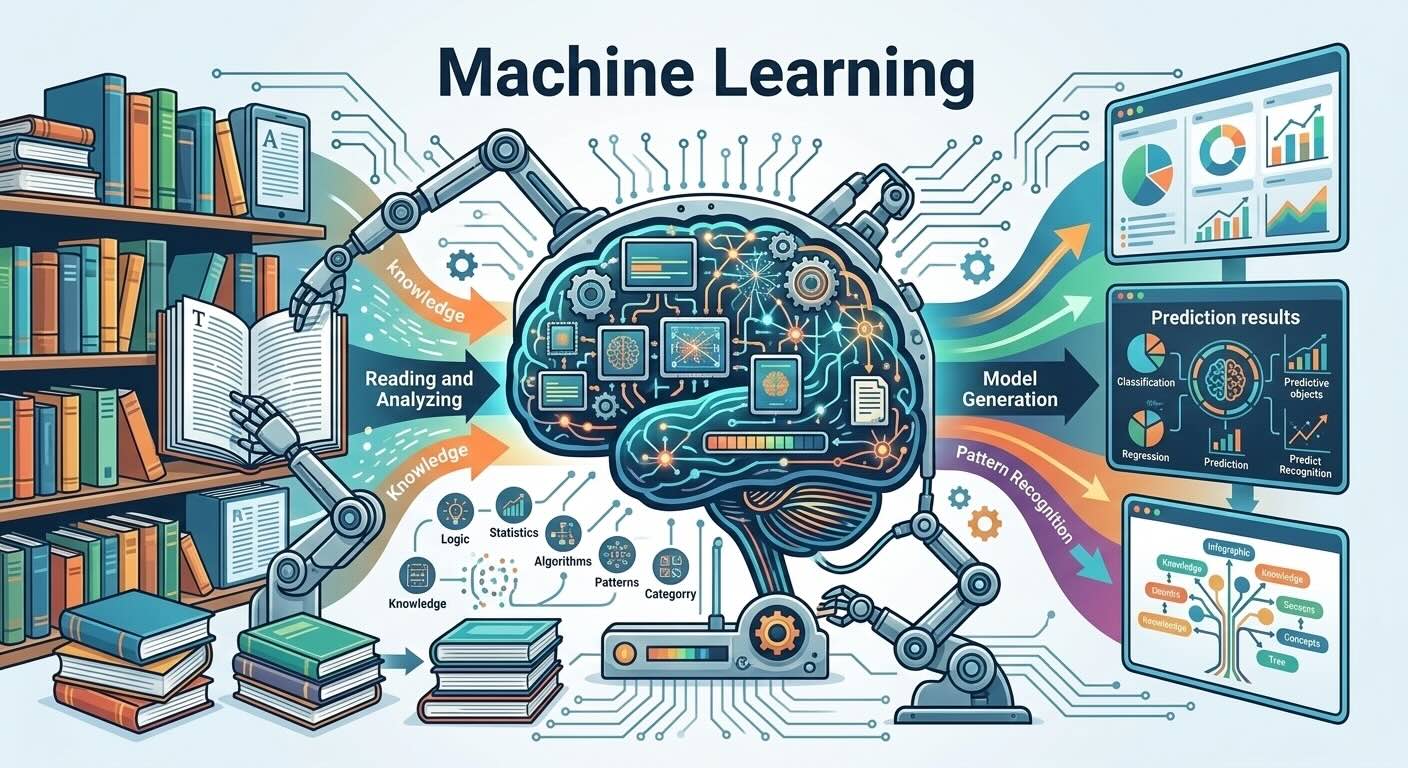
This is the core idea of machine learning: systems that learn from examples.
A Simple Analogy
Imagine teaching a child to recognize dogs.
You don't give them a rulebook that says:
A dog has four legs, fur, a tail, and makes a barking sound.
Instead, you point at many different dogs and say "dog." You point at cats, birds, and cars and say "not a dog."
After enough examples, the child can recognize a dog they've never seen before.
Machine learning works the same way. Show the system enough labeled examples, and it learns to generalize.
How Machine Learning Actually Works
Here is the basic process behind most machine learning systems:
1. Collect data
You need lots of examples — emails, images, measurements, text, transactions, whatever is relevant to your problem.
More data generally means better results.
2. Label the data
Each example needs an answer attached to it.
- This email is spam / not spam
- This photo contains a cat / does not contain a cat
- This tumor is malignant / benign
Labels tell the system what the correct answer is for each example.
3. Train the model
A machine learning algorithm processes all the labeled examples and builds an internal mathematical model — a large set of numbers that captures the patterns it found.
This process is called training.
4. Evaluate the model
You test the trained model on new examples it has never seen before.
How accurate is it? Does it generalize well, or did it just memorize the training data?
5. Use the model
Once the model performs well enough, you deploy it.
Now it can make predictions on new, unseen inputs — classifying emails, recognizing faces, recommending products.
Types of Machine Learning
There are three main flavors of machine learning, each suited to different kinds of problems.
Supervised learning
The most common type. You train the model on labeled examples.
Examples:
- Spam detection (spam / not spam)
- Disease diagnosis from medical scans
- Predicting house prices from features
The model learns a mapping from inputs to outputs.
Unsupervised learning
No labels provided. The model finds structure in the data on its own.
Examples:
- Grouping customers by purchasing behavior
- Detecting unusual patterns in network traffic
- Compressing images by finding redundancies
The model discovers hidden patterns without being told what to look for.
Reinforcement learning
The model learns by trial and error, receiving rewards for good actions and penalties for bad ones.
Examples:
- Teaching AI to play chess or video games
- Training robots to walk
- Optimizing decisions in complex environments
This is how many game-playing AIs (like the ones that defeated world champions at Go and chess) were trained.
Real-World Machine Learning in Your Life
Machine learning is already embedded in everyday technology:
| Product | Machine Learning Task | |---|---| | Gmail | Classifying spam and categorizing emails | | Spotify | Recommending songs based on your taste | | Netflix | Suggesting shows you might like | | Google Maps | Predicting travel time based on traffic | | Your phone camera | Recognizing faces and scenes | | Credit card fraud detection | Spotting unusual transactions |
Almost every product you use daily relies on machine learning in some form.
Machine Learning and AI — What's the Difference?
People often use "AI" and "machine learning" interchangeably, but they're not the same thing.
Artificial Intelligence (AI) is the broad goal: building machines that can do things that typically require human intelligence.
Machine learning is one of the primary methods used to achieve that goal.
Think of it this way:
- AI is the destination
- Machine learning is the most popular road to get there
There are other roads — traditional rule-based systems, expert systems, symbolic AI — but machine learning has become dominant because it scales so well with data.
Why Machine Learning Changed Everything
For decades, AI progress was slow because hand-coding rules for complex tasks was nearly impossible.
Machine learning changed that by allowing systems to:
- learn from data automatically
- handle messy, real-world inputs
- improve as more data becomes available
- scale to problems no human could manually program
The combination of machine learning with large datasets and powerful computers created the AI revolution we're experiencing today.
Final Thoughts
Machine learning is not magic. It's a systematic approach to building software that learns patterns from examples instead of following hand-written rules.
It's the foundation of nearly everything we call AI today — from spam filters to self-driving cars to ChatGPT.
Keep learning
- What Is a Neural Network? (No Math Required) — the algorithm powering most modern machine learning
- AI vs. Machine Learning vs. Deep Learning: What's the Difference? — clear up the terminology once and for all
- What Is Generative AI? A Simple Explanation — see how machine learning leads to AI that creates content
- What Is AI and Why It Matters For You — the starting point if you're brand new
Continue reading

2026-03-10
The AI Mexican Standoff in Tech
2026-03-10
I Vibe Coded an IntelliJ Plugin in 30 Minutes With Zero Plugin Dev Experience

2026-03-09
Should You Still Learn to Code in 2026?
2026-03-08
AI in 2026 So Far: Key Trends Everyone Should Know
2026-03-07
AI Hallucinations: Why AI Makes Things Up (And What to Do About It)
2026-03-04