2026-02-20
AI vs. Machine Learning vs. Deep Learning: What's the Difference?
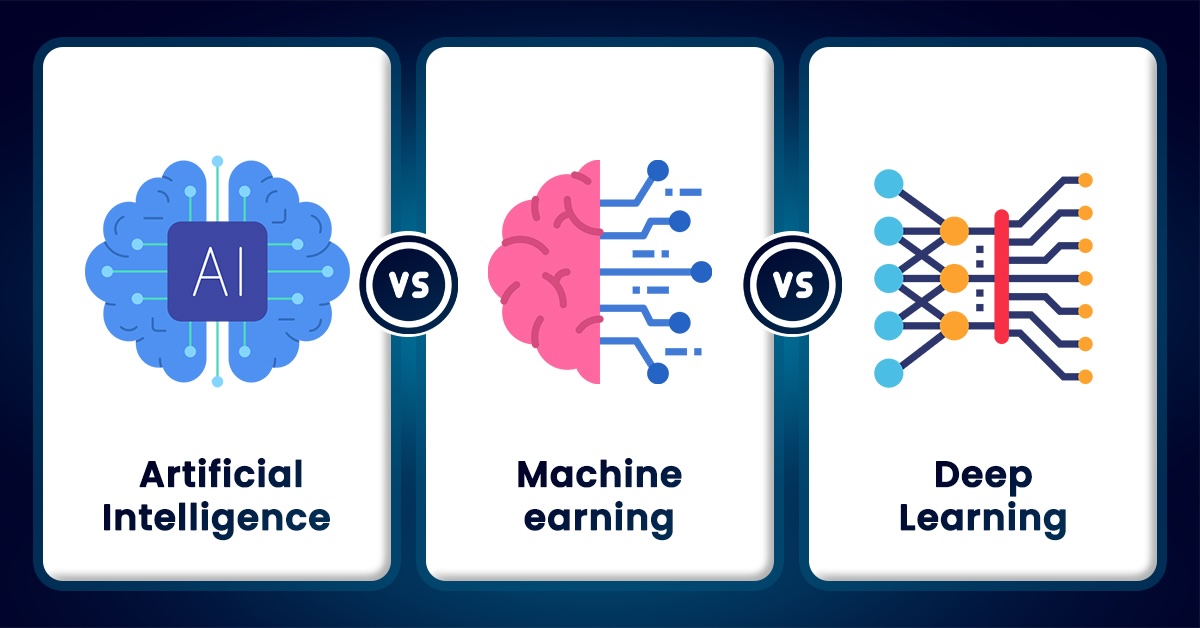
Introduction
"AI," "machine learning," and "deep learning" get thrown around constantly — often interchangeably, often incorrectly.
Tech articles use them as synonyms. Marketing teams slap "AI" on products that barely qualify. Meanwhile, "deep learning" sounds like something from a philosophy course.
This article cuts through the confusion with a single clear framework.
The Short Answer
These three terms form a nested hierarchy:
Artificial Intelligence
  └── Machine Learning
        └── Deep Learning
- AI is the biggest, broadest concept.
- Machine learning is a subset of AI — a specific approach to building intelligent systems.
- Deep learning is a subset of machine learning — a specific technique using multi-layered neural networks.
Every instance of deep learning is machine learning. Every instance of machine learning is AI. But not every AI system uses machine learning, and not every machine learning system uses deep learning.
Artificial Intelligence: The Broad Goal
Artificial Intelligence is the general concept of building machines that can perform tasks that normally require human intelligence.
That's it. It's a goal, not a technique.
AI includes:
- Solving puzzles
- Recognizing speech
- Playing games
- Making decisions
- Translating languages
- Generating images and text
AI has been around as a field since the 1950s. Early AI systems were mostly hand-programmed rule sets — no learning involved.
Example of AI that is NOT machine learning:
- A chess program from the 1990s that followed thousands of hand-written rules ("if opponent moves here, counter with this")
- A spam filter with manually written keyword rules
- A customer service chatbot following a decision tree
These are AI systems. They behave intelligently. But they don't learn — a human programmed every rule.
Machine Learning: AI That Learns From Data
Machine learning is a specific approach to building AI systems — one where the computer learns patterns from data rather than following explicitly programmed rules.
Instead of:
If email contains 'FREE MONEY', mark as spam
Machine learning says:
Here are 1 million labeled emails. Figure out what makes something spam.
The system discovers its own rules from examples.
This approach became dominant because it scales. You can feed a machine learning system more data and it generally gets better — without a programmer having to manually update any rules.
Examples of machine learning:
- Spam filters that adapt as spam tactics evolve
- Recommendation engines on Netflix or Spotify
- Fraud detection that flags unusual transactions
- Image recognition identifying objects in photos
Machine learning uses many different algorithms: decision trees, support vector machines, random forests, linear regression, k-nearest neighbors... and yes, neural networks.
Deep Learning: Machine Learning With Neural Networks
Deep learning is a specific type of machine learning that uses deep neural networks — networks with many layers of interconnected nodes.
The "deep" refers to the depth of these layers.
What makes deep learning special?
Traditional machine learning algorithms often required humans to engineer the right features — deciding which aspects of the data matter (pixel brightness, word frequency, transaction amount).
Deep learning learns its own features automatically from raw data.
A deep learning image classifier doesn't need someone to manually specify "look for edges, then shapes, then objects." It learns that hierarchy on its own through training.
This made deep learning dramatically more capable at:
- Images: recognizing faces, diagnosing tumors, identifying objects
- Audio: speech recognition, music analysis, voice cloning
- Text: translation, summarization, generation (language models!)
- Video: understanding scenes, tracking movement
Examples of deep learning:
- Face recognition on your phone
- Google Translate
- ChatGPT and other LLMs
- Self-driving car perception systems
- AI image generators (Midjourney, DALL-E)
A Side-by-Side Comparison
| | AI | Machine Learning | Deep Learning | |---|---|---|---| | What it is | Broad goal: intelligent machines | Method: learning from data | Technique: multi-layer neural networks | | Requires data? | Not necessarily | Yes — labeled examples | Yes — large amounts | | Learns automatically? | Not always | Yes | Yes | | Needs feature engineering? | Sometimes | Often | No — learns features itself | | Computational cost | Varies | Moderate | High | | Best for | Many kinds of tasks | Structured data problems | Complex patterns in images, text, audio |
Why Did Deep Learning Dominate?
Through most of AI history, machine learning required careful feature engineering — human experts had to decide what to measure.
Deep learning bypassed that bottleneck. Given enough data and computing power, deep neural networks extract relevant features automatically.
Three factors aligned in the early 2010s to make this possible:
- Big data — the internet produced enormous labeled datasets (ImageNet had 14 million labeled images)
- GPUs — graphics cards turned out to be perfect for the parallel math that neural networks require
- Better algorithms — improvements in training techniques made deep networks actually learnable
The result was a dramatic breakthrough in image recognition in 2012 that launched the deep learning era.
How They Relate in Practice
Modern AI products typically involve all three layers:
| Product | AI (goal) | Machine Learning (method) | Deep Learning (technique) | |---|---|---|---| | ChatGPT | Conversational assistant | Trained on human feedback | Transformer neural network | | Google Photos | Organize and search images | Learned from labeled photos | Convolutional neural network | | Spotify | Music recommendations | Learned from listening patterns | Combined approach | | Self-driving cars | Navigate autonomously | Learned from millions of miles | Multiple deep networks |
Final Thoughts
- AI is the destination: intelligent machines.
- Machine learning is the primary road: systems that learn from data.
- Deep learning is the most powerful vehicle on that road: multi-layer neural networks.
Understanding these distinctions makes you a much sharper reader of tech news — and gives you a solid foundation for understanding everything happening in AI today.
Keep learning
- What Is Machine Learning? A Plain-English Guide — a deeper dive into machine learning
- What Is a Neural Network? (No Math Required) — understanding the engine behind deep learning
- What Is an LLM? How Language Models Actually Work — the deep learning technology behind ChatGPT
- What Is AI and Why It Matters For You — start here if you're brand new to AI
Continue reading

2026-03-10
The AI Mexican Standoff in Tech
2026-03-10
I Vibe Coded an IntelliJ Plugin in 30 Minutes With Zero Plugin Dev Experience

2026-03-09
Should You Still Learn to Code in 2026?
2026-03-08
AI in 2026 So Far: Key Trends Everyone Should Know
2026-03-07
AI Hallucinations: Why AI Makes Things Up (And What to Do About It)
2026-03-05