2026-03-10
The AI Mexican Standoff in Tech
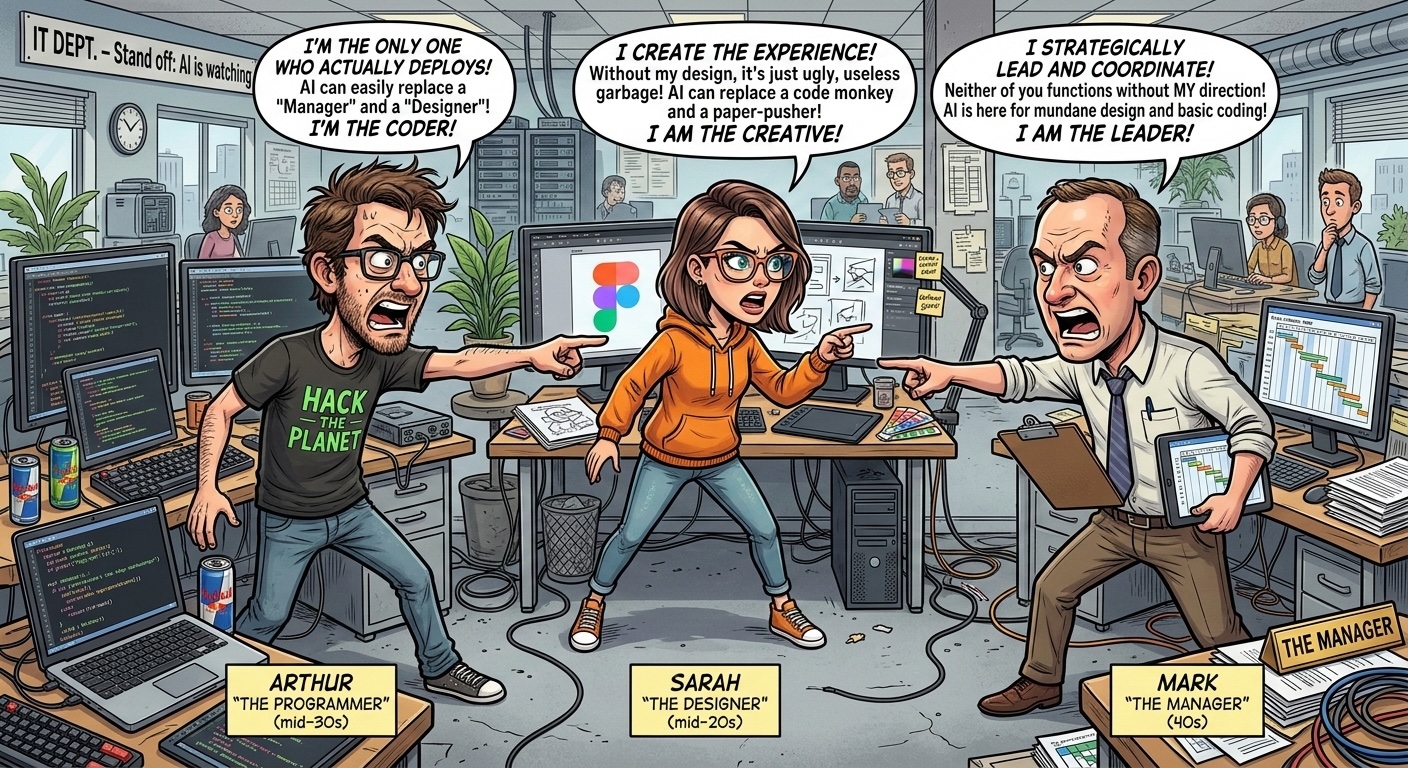
The New Tension in Tech
Recently, venture capitalist Marc Andreessen described the current atmosphere in tech as a “Mexican standoff.”
It’s a surprisingly accurate metaphor.
In many companies today, three roles are quietly pointing guns at each other:
- Engineers
- Designers
- Product managers
Each group has started to suspect that AI might make the other two less necessary.
But here’s the twist: they might all be partially right.
The Engineer’s Perspective
From the engineer’s point of view, modern AI tools can already do a lot of the work that used to require entire teams.
With the help of AI, developers can:
- generate UI layouts
- produce design ideas
- write documentation
- outline product roadmaps
- rapidly prototype features
If an engineer can build, design, and prototype quickly with AI assistance, the traditional boundaries between roles start to blur.
The Product Manager’s Perspective
Product managers are seeing the same shift from a different angle.
AI tools now allow them to:
- create working prototypes
- generate product specs
- analyze user feedback
- simulate feature ideas
Tasks that previously required weeks of engineering effort can now sometimes be mocked up in hours.
From their perspective, AI lowers the barrier between product ideas and working software.
The Designer’s Perspective
Designers are experiencing the same transformation.
Modern AI tools can help them:
- generate front-end code
- create animations and assets
- produce design systems
- build functional UI prototypes
In some cases, designers can now go from concept to working product interface without needing a large development team.
The Collapse of Traditional Boundaries
Historically, tech companies operated with clear role separation:
- Engineers built the system
- Designers shaped the experience
- Product managers defined the direction
AI is starting to dissolve these boundaries.
Not because these roles disappear — but because the capabilities required to perform them are becoming more accessible.
A single motivated person can now do work that previously required multiple specialists.
The Rise of the “Superpowered Individual”
This shift creates a new kind of professional.
Not a specialist locked into one discipline, but someone who can combine multiple skill sets using AI as leverage.
Examples include:
- a developer who can design and ship products independently
- a designer who can implement and deploy interfaces
- a product thinker who can prototype real software
Instead of protecting job titles, these individuals focus on expanding their capabilities.
They become what some call “triple threats.”
AI as a Force Multiplier
The key insight here is that AI does not simply replace skills — it amplifies them.
A developer with strong product intuition becomes far more powerful.
A designer who understands code becomes dramatically more effective.
A product manager who can prototype ideas instantly becomes much more influential.
AI acts as a force multiplier for people willing to step outside traditional roles.
The Real Risk
Ironically, the biggest risk may not be AI replacing jobs directly.
The bigger risk is refusing to expand beyond a narrow specialization.
In a world where tools allow individuals to move across disciplines, staying confined to a single role can become a disadvantage.
The people most at risk are not those competing with AI — but those ignoring it.
Final Thoughts
The tech industry may indeed feel like a “Mexican standoff” right now.
Engineers, designers, and product managers are all realizing that AI changes the balance of power.
But instead of eliminating roles, AI may simply reward those who adapt the fastest.
The future may belong to individuals who are not defined by a single title, but by their ability to combine skills, tools, and creativity to build real things.
In that world, the question is no longer:
What is your role?
Instead, the question becomes:
What can you create?
Related reading
- Should You Still Learn to Code in 2026? — a deeper look at how AI is changing the programming profession
- AI in 2026 So Far: Key Trends Everyone Should Know — the macro trends behind this shift in tech roles
- What Is Generative AI? A Simple Explanation — the technology that's enabling individual creators to do more
Continue reading
2026-03-10
I Vibe Coded an IntelliJ Plugin in 30 Minutes With Zero Plugin Dev Experience

2026-03-09
Should You Still Learn to Code in 2026?
2026-03-08
AI in 2026 So Far: Key Trends Everyone Should Know
2026-03-07
AI Hallucinations: Why AI Makes Things Up (And What to Do About It)
2026-03-05
What Is Machine Learning? A Plain-English Guide
2026-03-04